Autonomous Minefield Navigation Swarm
Drone Swarm
Case study for a custom autonomous minefield navigation swarm, designed for high-performance robotic competition.
Project Team
-
Dr. Ajit Kumar Mentor
-
 Husain Lokhandwala
Collaborator - CAD/Embedded Sys.
Husain Lokhandwala
Collaborator - CAD/Embedded Sys.
- Adidev Shah Collaborator
-
Falgun Baria Collaborators
The Challenge
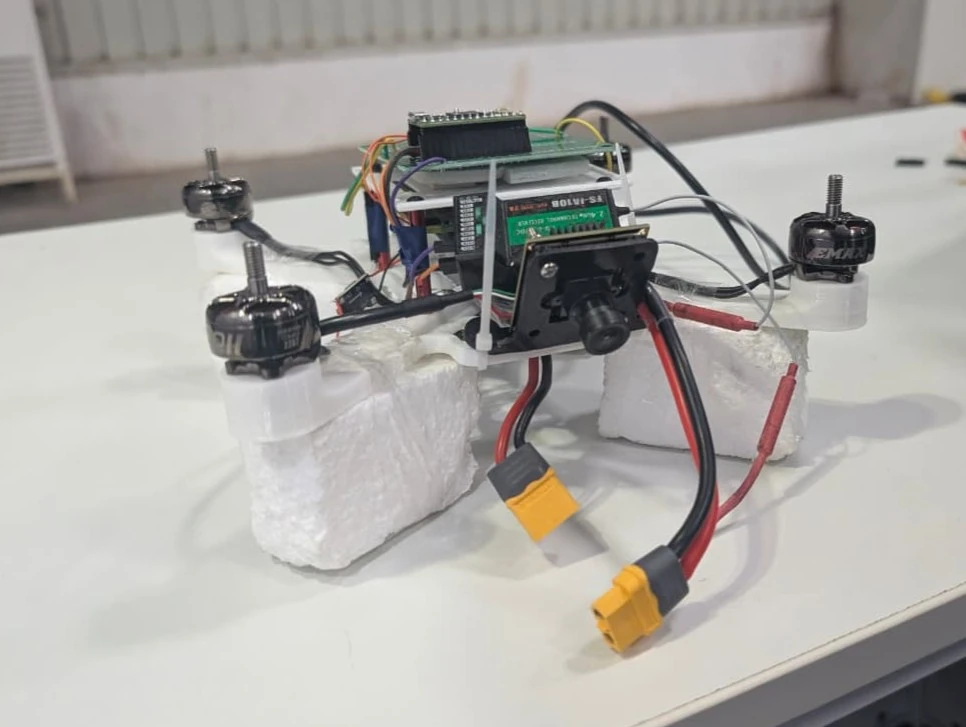
The Robofest Minefield Navigation Challenge required a swarm of micro aerial vehicles under 500g to autonomously map and mark safe corridors through a simulated minefield. We needed a custom flight architecture from scratch that could handle pathfinding and thermal detection. My role on the team focused on the mechanical design, custom payload integration, and weight optimization of the drone hardware.
Technical Deep Dive
3D Printing & Hardware Architecture
- Optimized 3D Printed Chassis: I engineered a lightweight Quad-X frame using PLA. I optimized the custom CAD design to minimize vibration transmission to the flight controller while maximizing the thrust-to-weight ratio to keep the drone strictly under the 500g competition limit.
- Custom Payload Mounts: I designed and 3D-printed vibration-isolated mounts for the MLX90640 thermal arrays. I also integrated a custom liquid dispenser mechanism utilizing an SG90 servo for the marker drone, relying on rapid 3D prototyping iterations to get a perfect fit.
- Avionics Deck Integration: I designed a custom PCB carrier board for the Teensy 4.0/4.1, integrating the sensor suite (MPU-6050, MTF-01 optical flow, and DPS310 barometer) directly into the 3D printed frame.
Firmware & Swarm Control
- Custom Teensy FC: The team developed a proprietary C++ flight controller running PID loops at 400 Hz.
- Sensor Fusion & Swarm Intelligence: We implemented complementary filters for GPS-denied indoor loitering and deployed a Raspberry Pi 4 master node running OpenCV to coordinate the swarm.
Results
- Weight Optimization: I successfully integrated complex computing and payload systems into the 3D printed chassis while keeping the master drone at 469g and scout drones at 397g, well under the 500g limit.
- Pathfinding Success: We successfully validated an A* algorithm that dynamically generates a low-risk corridor using thermal data.
- Competition Finalist: The synergy between my hardware designs and the software stack secured us a finalist position and a ₹2 lakh prize at Robofest Gujarat 5.0.
Have a Similar Project?
Let's bring your idea to life with affordable 3D printing and expert drone services.